

A packed diary feels like proof that things are going well. Enquiries keep coming in. The bookings fill up. There's barely a free evening left. So it's natural to assume the money is following.
Sometimes it is. But busy and profitable are two different things. You can be flat out all week and still earn far less per hour than you'd accept from an employer. The only way to know which one you've got is to look behind the bookings.
This applies whether you see clients one to one, run classes, or sell packages of time like a VA. Here are five places where busy and profitable tend to part company. Each one comes with something to try on your own business.
1. The hours nobody pays you for
When you set a price, you're usually thinking about the time you spend with the client. That's rarely the whole of it. There's also:
travel there and back
setting up and packing away
replying to messages and chasing payments
posting on social media
keeping the books
Here's a simple example. Say you charge £40 for a one-hour session. Add half an hour of travel, fifteen minutes of preparation and fifteen minutes of admin. That one hour has now become two. So before any costs come out, you're earning £20 an hour, not £40.
Classes work the same way. Eight people paying £8 for a one-hour class looks like £64 an hour. Now take off £20 for the hall. Then add an hour and a half for travel, setting up, packing away and handling bookings. That leaves £44 for two and a half hours, which is about £17.60 an hour.
So do packages. A £150 package of five hours a month sounds like £30 an hour. But if emails, check-ins and switching between clients stretch it to seven hours, it's nearer £21.
None of that extra time is optional. It just never shows up on the invoice.
Try this: take a typical week and note every bit of time your business uses, not just the booked hours. Then divide what you earned by the total.
2. A full diary can hide a low price
Being booked up can feel like a sign that everything's working. It might be. But it might also mean your prices haven't kept up with your experience, your costs, or what you now deliver.
Low prices fill a diary quickly. Once it's full, the only way to earn more is to work longer. That's one way skilled, hardworking people end up exhausted and still wondering where the money went.
One belief I've seen time and again is that charging less will bring in more clients and keep them coming back. It often comes with the idea that a low price is the inclusive choice, because it makes your work open to everyone.
It's easy to see the appeal. The difficulty is that a business which can't pay its owner properly is hard to keep going. And if it closes, it isn't open to anyone. If making your work accessible matters to you, you can do it deliberately. A lower-priced option or a few concession places can do that job, without underpricing everything you offer.
Try this: when did you last review your prices? Write down what has changed since then, such as your costs, your training and your experience. Does your price reflect any of it?
3. Not all work earns the same
Some services, clients or days bring in far more for your time than others. For example:
a booking across town at rush hour
a class that rarely fills
a package client who needs far more than the hours they bought
a service that takes ages to prepare
a discount you gave once and never stopped giving
On their own, these seem minor. Added together, they can be the gap between a business that pays you properly and one that just keeps you occupied.
Try this: list your services or regular clients. For each one, work out roughly what you earn once the extra time and costs are counted. Which ones surprise you?
4. Costs that creep up without you noticing
A price that worked a few years ago may not work now. Fuel, room hire, materials, software, insurance and card fees tend to rise a little at a time. Each increase is small enough to shrug off. Meanwhile, your price stays where it was.
The result is a margin that shrinks year by year, while the diary looks exactly the same. Nothing feels wrong, because nothing changed overnight.
Try this: add up what your business cost to run this month. Then compare it with the same month a year or two ago. Where has the biggest change been?
5. The extras you give away
Most people who work with clients are generous by nature. It's part of why clients love them. But the extras soon add up, such as:
a session or class that runs fifteen minutes over
a package that slowly grows beyond what was agreed
a long reply to a question sent late at night
advice over a coffee that turns into a free consultation
Each one feels like good service, and good service matters. The trouble comes when extras become expected and the time they take is never counted. Over a month, these small kindnesses can add up to days of unpaid work.
Try this: for the next fortnight, keep a quick note of anything you do for clients beyond what they've paid for. Then decide which extras you're happy to keep giving, and which belong in your price or a separate service.
What's worth measuring instead
Busy is easy to spot. Profitable needs a closer look at three things: what's coming in, what it really costs you in time and money, and what's left at the end. Once that's clear, it's much easier to decide on pricing, which work to keep, and where to put your energy.
My background is in corrective exercise, biomechanics and Pilates. I specialise in working from the feet up.
When one part of the body isn't working properly, the problem often shows up somewhere else. If your feet aren't doing their job, for example, your knees might start to hurt. You might even find you wee a little when you sneeze. Treat only the knees, and the pain keeps coming back.
My skill has always been finding the underlying cause, and businesses are no different. A quiet month might come down to pricing. A worn-out owner might come down to all the extras nobody counts. What I do is put those pieces together, then follow the problem back to where it really starts.
The aim isn't to fill more hours. It's to know what the hours you already work are truly worth.
Which of these rang true for you? Leave a comment below.
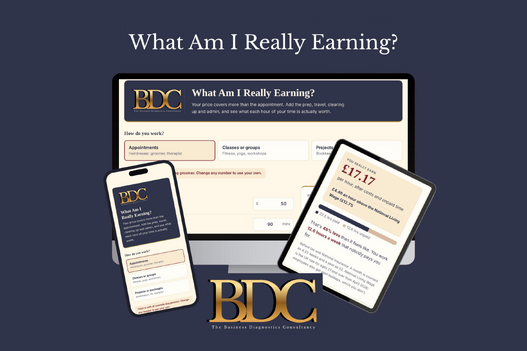
If you'd like to see your own figures, try my free calculator, What Am I Really Earning? It works out your true hourly rate once travel, preparation, admin and costs are included. Just pop in your numbers and it does the maths for you.
Find Out What You're Really Earning → Income Calculator

Comments